Free · 7 formulas · kg & lb
1 Rep Max Calculator
Enter one hard set and get your max, training weights, warm-ups and plate loading in seconds.
Your set
Estimated 1RM
Bench Press
Enter the weight and reps from one hard set. Your max, training weights and plate loading appear here instantly.
Enter a set to compare formulas.
Enter a set to build your warm-up.
Enter a set to see the full table.
Enter a set to see your rep maxes.
Levels are approximate bodyweight-multiple standards for adult lifters. Age, height and training history all shift them.
DOTS uses the 2020 coefficients and Wilks the original ones, both calculated in kg. Scores from estimated maxes are a guide, not a meet result.
Enter a target and a date.
Rough guide: under 0.5% a week is realistic, 0.5–1% is ambitious and over 1% is very aggressive for most trained lifters.
2:00
Beeps and vibrates (where supported) when time is up. Keep this tab open while you rest.
Type any target weight.
Stored only in this browser on this device. Nothing is sent to our server.
Estimates only. Your real max depends on technique, sleep, and the day. Test heavy singles with a spotter or safeties.
To calculate your 1 rep max, take a hard set you finished with clean form and run it through a formula. The most popular is Epley: 1RM = weight × (1 + reps ÷ 30). Lift 100 kg for 5 reps and your estimated max is about 116.7 kg. This free one rep max calculator runs seven formulas at once and gives you the middle result.
Popular Max Calculators
On this page
How to Use This 1 Rep Max Calculator
This 1 rep max calculator turns one tough set into a full training plan. You don’t have to grind out a true max to know your numbers. The whole process takes about 30 seconds:
- Pick your lift. Tap Bench, Squat or Deadlift, or search all 42 lifts. The lift matters, because pull-ups, dips and dumbbell work need different inputs.
- Choose kg or lb. Switch whenever you like. Every number on the page converts instantly.
- Enter weight and reps. Use a recent set you finished with clean form, ideally 2–10 reps. The − and + buttons make reps quick to enter on a phone.
- Read your estimated 1RM. The big number is the median of seven formulas, so one odd formula can’t drag your result around.
- Open Coach mode for the formula comparison, RPE adjustment, warm-up ramp and the full percentage table.
- Load the bar and save. The plate calculator shows what goes on each side, and the progress tracker saves your estimate so you can watch the trend.
Want to send your numbers to a coach or training partner? Use Share link, which opens the calculator with your exact inputs. Or export a PDF and keep it in your gym bag.
Key takeaway: the best input is a recent, honest set of 3–6 reps. Feed the calculator a sloppy set and you’ll get a sloppy max back.
What Is a One Rep Max (1RM)?
Your one rep max is the heaviest weight you can lift for a single, full repetition with good technique. It is lift-specific. Your bench max tells you nothing about your squat max, and a paused bench max is a different number from a touch-and-go one.
1RM vs rep max
A rep max is the most you can lift for a set number of reps. If 100 kg is the most you can squat for five, that’s your 5-rep max. A one rep max calculator works backwards from that rep max to predict your single. It works because strength and rep capacity move together in a fairly predictable way, at least at low and moderate reps.
Why lifters bother knowing it
Most proven programs prescribe loads as percentages: 5×5 at 80%, a top single at 90%, back-off sets at 70%. Without a reasonable max, those numbers are meaningless. With one, every session has a clear target. If your squat max is 160 kg, 80% is 128 kg, so there’s no guessing in the warm-up area and no wasted sets.
Testing vs estimating
A true max test is a skill in itself. You need a proper warm-up, a spotter or safety pins, long rest periods and enough experience to read your own bar speed. It also costs recovery, and plenty of lifters feel flat for days afterwards.
Estimating from a submaximal set gets most trained lifters within a few percent, with a fraction of the risk and fatigue. Our advice: test a true max when it actually matters, like a meet or the end of a training block. Estimate the rest of the time, and let a 1RM calculator do the maths.
How Accurate Is a 1 Rep Max Calculator?
Accurate enough to train from, as long as you feed it a good set. For most experienced lifters, an estimate from 3–6 clean reps lands within a few percent of a tested max. Move outside that range and the margin of error grows.
The best rep range for an estimate
Sets of 2–10 reps give useful estimates, and 3–6 is the sweet spot. Past 10 reps, the set starts testing muscular endurance, breathing and pain tolerance more than maximal strength. Two lifters with the same max can do very different numbers of reps at 70%, so high-rep estimates scatter. That’s why this calculator caps input at 15 reps.
What throws the number off
- Technique drift. A squat that gets shallower or a bench that starts bouncing adds reps you didn’t really earn.
- Tempo and pauses. Paused reps are harder, so the same rep count with pauses points to a higher max than touch-and-go.
- Short rest. A set done after 60 seconds of rest will under-predict what you can do fresh.
- Fatigue. A set at the end of a long session, or after a bad night’s sleep, reads low.
- Your training background. Endurance-trained lifters often squeeze out more reps at a given percentage, which can inflate estimates. Lifters who live on heavy singles tend to get fewer.
Why the formulas disagree
Each formula was built from a different group of lifters using a different curve. Even on the same set they usually spread by 5–8%. That’s why the calculator shows you a range bar along with the main number. A tight range means your estimate is stable. A wide one means you should treat it as a range and train off the middle.
Key takeaway: use 3–6 reps, rest properly before the set, and keep your technique identical from the first rep to the last. That alone fixes most “my max feels wrong” problems.
The 7 One Rep Max Formulas, Explained
Here are all seven formulas this 1RM calculator uses. In every equation, w is the weight lifted and r is the number of reps. Each example uses the same set: 100 kg for 5 reps.
Epley
100 kg × 5 → 116.7 kgNamed after strength coach Boyd Epley. Simple and one of the most widely used formulas in strength training.
Brzycki
100 kg × 5 → 112.5 kgDeveloped by Matt Brzycki. More conservative than Epley below 10 reps and identical at exactly 10.
Lombardi
100 kg × 5 → 117.5 kgRuns a little high at low reps and noticeably low at high reps.
O’Conner
100 kg × 5 → 112.5 kgA simple linear model and the most conservative of the group at higher reps.
Wathen
100 kg × 5 → 116.6 kgAn exponential model that tracks closely with Epley across most rep counts.
Mayhew
100 kg × 5 → 119.0 kgBuilt from bench press research. Usually the most optimistic formula at low reps.
Lander
100 kg × 5 → 113.7 kgSits close to Brzycki at nearly every rep count.
Our main result: the median
100 kg × 5 → 116.6 kgRange 112.5–119.0 kg. Using the median stops any single formula from skewing your max.
How the formulas compare at 3, 5 and 10 reps
| Formula | 100 kg × 3 | 100 kg × 5 | 100 kg × 10 | Tendency |
|---|---|---|---|---|
| Epley | 110.0 | 116.7 | 133.3 | Middle of the pack |
| Brzycki | 105.9 | 112.5 | 133.3 | Low at low reps |
| Lombardi | 111.6 | 117.5 | 125.9 | High early, low late |
| O’Conner | 107.5 | 112.5 | 125.0 | Most conservative |
| Wathen | 109.0 | 116.6 | 134.7 | Close to Epley |
| Mayhew | 114.0 | 119.0 | 130.9 | Optimistic at low reps |
| Lander | 107.2 | 113.7 | 134.1 | Close to Brzycki |
Which formula should you use?
Honestly, consistency matters more than which one you pick. Choose one and stick with it so your progress numbers compare fairly over time. If you don’t have a preference, use our default median. If you bench a lot, Mayhew was built on that lift. If you’re naturally good at high reps, the conservative options (O’Conner or Lombardi) will keep your estimates honest.
1 Rep Max Calculator for Bench Press
The bench is where most people first want to know their max, and it’s also where estimates get inflated most often. Tap Bench above and the tool switches to bench mode: bench press set in, bench max out. These rules keep the number honest.
Set up the same way every time
Plant your feet, pin your shoulder blades back and down, use the same grip width and touch the same spot on your chest. Change any one of those and you’ve effectively changed the lift, so your estimates stop being comparable.
Which bench are you entering?
- Paused (competition style): fewer reps at a given weight, but the cleanest data you can get.
- Touch-and-go: more reps thanks to the stretch reflex. Fine to use, as long as you never bounce.
- Incline and close-grip: track these as separate lifts. Don’t mix them with your flat bench numbers.
- Dumbbell bench: use the per-dumbbell or total toggle so your load isn’t accidentally doubled.
Mistakes that inflate a bench estimate
Bouncing the bar off your chest, your hips lifting off the bench, stopping short of lockout, and counting a rep your spotter touched. Any one of these can add 5–10% to your “max” that won’t be there on the day.
Worked example
You bench 185 lb for 6 clean reps. The calculator puts your max at about 221 lb. For a strength block, 85% is roughly 188 lb, so a heavy triple at 185–190 lb makes sense. For muscle-building work, 70–75% lands around 155–165 lb for sets of 8–10.
Want a page built only for pressing? Our 1 rep max calculator bench page adds bench-specific tips, variations and percentages.
Squat Max Calculator: Back Squat and Front Squat
In the squat, depth decides everything. Only use this as a squat max calculator with reps that all hit the same depth. Otherwise the result reflects how much you cut, not how strong you are.
Squat checklist before you trust the number
- Brace before you unrack and re-brace before every rep.
- Hit the same depth every rep. For a competition squat, that means the hip crease below the top of the knee.
- Keep the same bar position. High bar and low bar use different leverages, so log them as separate lifts.
- Watch for the hip shoot. If your hips rise faster than your chest on the last reps, the set became a good morning. End the set before that point.
Front squat notes
Many lifters front squat roughly 80–85% of their back squat. The limiter is usually the upper back and the rack position, not the legs. Front squat sets end the moment your elbows drop, so keep front squat estimates to sets of 3–5.
Worked example
You back squat 140 kg for 5 reps at consistent depth. Your estimated max comes out at about 163 kg. Strength work at 80–85% puts your working sets at 130–139 kg, while volume days at 70% sit around 114 kg.
For a squat-only tool with depth checks and front squat guidance, use the dedicated squat max calculator.
Key takeaway: a squat estimate is only as good as your worst rep’s depth. Film one set from the side and check.
Deadlift Max Calculator: Conventional, Sumo and Trap Bar
Deadlift reps behave differently from presses. Your grip, lower back and breathing all fatigue at once, so the first rep is usually your best and the last is your worst. Estimates from 2–5 reps are far more reliable than estimates from 8 or more.
Conventional vs sumo
They’re both deadlifts, but they’re different movements with different leverages. Track them separately. Your sumo max doesn’t convert neatly into a conventional max, or the other way round.
Trap bar and Romanian deadlift
The trap bar lets most people lift noticeably more because of its upright position and centered load. That makes it a great training lift, but its max isn’t a stand-in for your barbell deadlift. The RDL is a different exercise again, limited by hamstring length and position, so log it on its own.
Reset every rep
Count only reps that start from a dead stop on the floor. Touch-and-go pulls use the bounce and inflate your estimate.
Worked example
You pull 180 kg for 3 clean reps. The median estimate is about 196 kg, with a range of 190.6–205.2 kg. Train off the 196, not the hopeful 205. Deadlifts generally respond best to 75–90% for low reps with plenty of rest between sets. Our deadlift max calculator covers each pulling style in more detail.
Using the Max Calculator for Other Lifts
Bench, squat and deadlift get the attention, but this 1 rep max calculator handles 42 lifts. What matters is entering the load your body actually moved.
| Lift type | Examples | What to enter |
|---|---|---|
| Barbell | Overhead press, barbell row, hip thrust | Total bar weight, plates and bar |
| Dumbbell | Dumbbell bench, shoulder press, rows | Per dumbbell or total, using the toggle |
| Machine | Leg press, leg extension, cable row | The listed stack or sled weight (machine-specific) |
| Bodyweight plus load | Weighted pull-ups, weighted dips | Your bodyweight plus the added weight |
| Olympic | Power clean, snatch | Sets of 1–3 only, since speed drops fast |
Weighted pull-up example: you weigh 80 kg and do 5 reps with 20 kg on a belt. The calculator uses 100 kg as the load, estimates a total of about 116.6 kg, and tells you that’s roughly +36.6 kg of added weight for a single.
A few lift-specific notes. The overhead press only counts with no leg drive and full lockout. Machines vary between gyms, so compare machine maxes on the same machine only. Curls get sloppy fast, so count strict reps only.
Stopped Short of Failure? Use RPE and Reps in Reserve
Most of your sets shouldn’t go to failure, and the calculator doesn’t need them to. If you stopped with reps left in the tank, add your RPE (rate of perceived exertion) in Coach mode and the calculator will account for it.
| RPE | Reps left in reserve | How it felt |
|---|---|---|
| 10 | 0 | Nothing left. A true limit set. |
| 9.5 | 0–1 | Maybe one more rep, maybe not |
| 9 | 1 | One more rep was definitely there |
| 8 | 2 | Hard but controlled |
| 7 | 3 | Fast reps, solid working set |
| 6 | 4 | Moderate, warm-up territory |
Example: 225 lb for 8 reps at RPE 8 means you had 2 reps left, so the calculator treats it as a 10-rep max. That gives an estimate of about 300 lb. Without the RPE, the same set would read around 281 lb.
RPE works best once you’ve trained consistently for a while. If you’re new, your sense of “two reps left” is often off by a rep or two, so lean on straight rep counts first.
1RM Percentage Chart
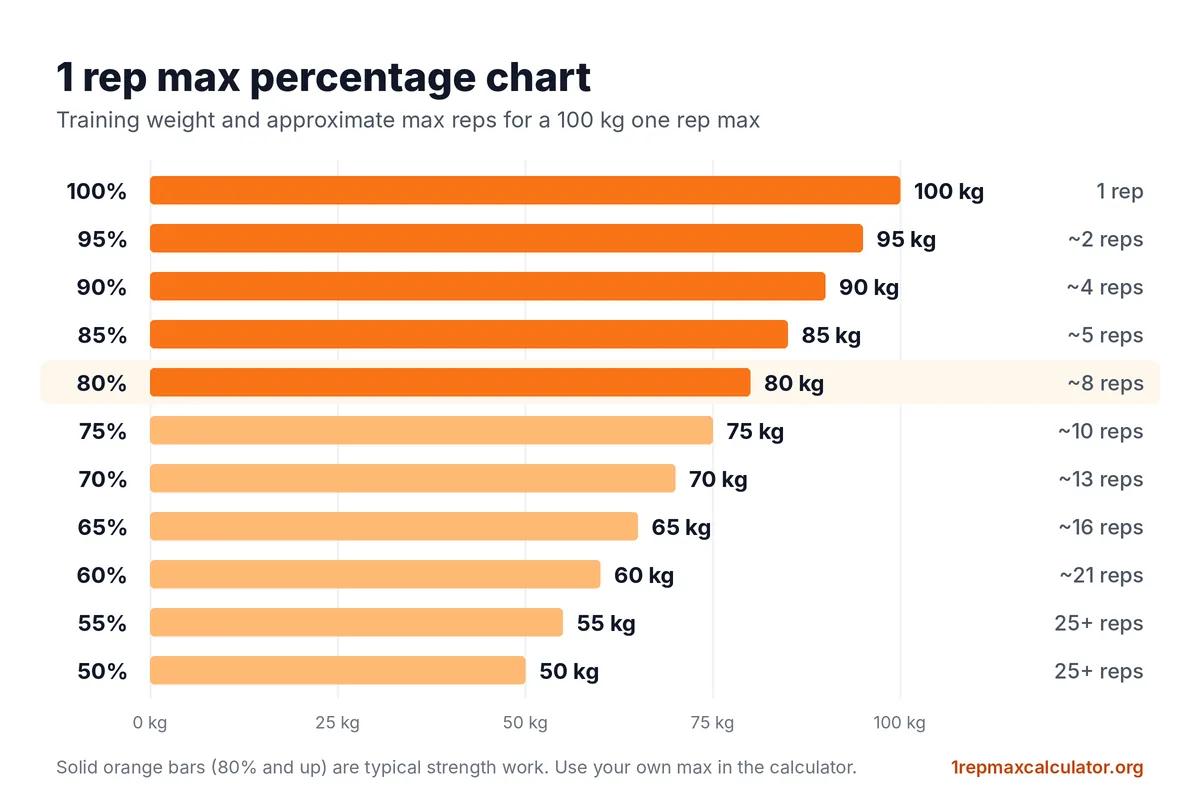
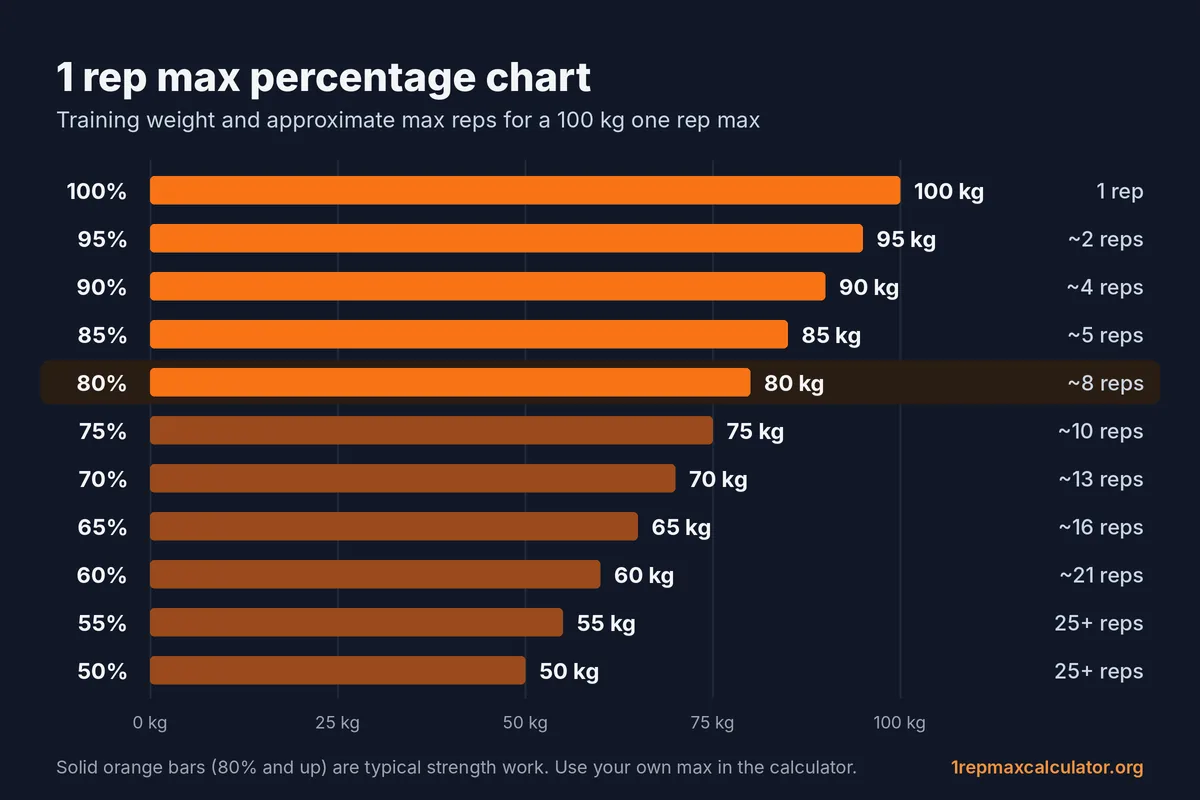
Once the 1 rep max calculator gives you a number, this chart turns it into working weights. Rep numbers are approximate and based on a typical strength curve. Your own numbers may run a rep or two higher or lower.
| % of 1RM | Approx. reps | 1RM 100 kg | 1RM 300 lb | Typical use |
|---|---|---|---|---|
| 100% | 1 | 100 kg | 300 lb | Testing, competition |
| 95% | 2 | 95 kg | 285 lb | Peaking singles and doubles |
| 90% | 3–4 | 90 kg | 270 lb | Heavy strength work |
| 85% | 5–6 | 85 kg | 255 lb | Strength |
| 80% | 7–8 | 80 kg | 240 lb | Strength and size |
| 75% | 9–10 | 75 kg | 225 lb | Hypertrophy |
| 70% | 12–13 | 70 kg | 210 lb | Hypertrophy, volume |
| 65% | 15–16 | 65 kg | 195 lb | Volume, technique |
| 60% | about 20 | 60 kg | 180 lb | Endurance, speed work |
| 50% | 25+ | 50 kg | 150 lb | Warm-ups |
The calculator builds this table automatically from your own max, with plate-friendly rounding to 0.5, 1 or 2.5 kg, or 1, 2.5 or 5 lb.
How to Train From Your 1 Rep Max
Your max is a tool, not a trophy. Here’s how to turn the number from any one rep max calculator into training that actually moves it.
| Goal | % of 1RM | Reps per set | Sets | Rest |
|---|---|---|---|---|
| Maximal strength | 80–90% | 1–5 | 3–6 | 3–5 min |
| Muscle growth | 65–80% | 6–12 | 3–5 | 1–2 min |
| Strength endurance | 50–65% | 12–20 | 2–4 | 45–90 sec |
| Speed and technique | 50–70% | 1–3, fast | 5–8 | 1–2 min |
Pick one way to progress at a time
- Add weight and keep the reps the same.
- Add reps at the same weight until you hit the top of your range.
- Add a set to increase total volume.
Push one lever for 3–6 weeks. Pull all three at once and you won’t know what’s working, and you’ll probably run yourself into the ground.
Use a training max for percentage programs
Programs like 5/3/1 base their percentages on a training max, usually 90% of your 1RM. With a 1RM of 150 kg, your training max is 135 kg. Every percentage in the program is calculated from 135, which builds in a buffer for bad days. Coach mode lets you switch the percentage table to a training max.
When to re-estimate
Every 4–8 weeks, or whenever you clearly beat a previous set, like more reps at the same weight. If your estimate drops, check sleep, stress and rest times before blaming your program.
Key takeaway: train mostly at 70–85%, test or estimate every few weeks, and let the number follow the work.
How to Load the Bar: Plate Calculator Guide
Doing plate math mid-workout wastes time and invites mistakes. Enter a target weight in the plate calculator and it shows exactly what goes on each side, with a visual of the loaded bar.
- 140 kg on a 20 kg bar is 25 + 25 + 10 kg per side.
- 315 lb on a 45 lb bar is three 45 lb plates per side.
- Odd targets: if a weight can’t be loaded exactly (say 143 kg with 1.25 kg as your smallest plate), the calculator shows the closest weight you can load, 142.5 kg, and tells you the difference.
Using competition collars? Tick the collar option and each 2.5 kg collar is counted. Training with a 15 kg women’s bar or a 35 lb bar? Select it as the bar weight and the plate math adjusts. For loading without estimating a max first, use the standalone plate calculator.
Track Your Strength Progress
A single estimate tells you where you are. A series of them tells you whether your training is working. Hit Save after any calculation in the 1 rep max calculator, and the progress tracker logs the date, the lift and your estimated 1RM, then charts it over time.
Your history is stored only in your browser on your device. Nothing is sent to our servers and there’s no account to create. You can delete a single lift’s history or clear everything in two taps.
Tip: for clean trend lines, estimate from the same rep scheme each time, such as your top set of 5 on squat day. Mixing triples one week and sets of 10 the next adds noise.
Frequently Asked Questions
How do I calculate my 1 rep max without testing it?
Do a hard set of 3–6 reps with good form, then enter the weight and reps into the one rep max calculator above. It runs seven established formulas, such as Epley, which multiplies the weight by one plus reps divided by 30, and shows the median. For most lifters, that lands within a few percent of a true max.
Is a 1RM calculator accurate?
For sets of 2–10 clean reps, a 1RM calculator is usually accurate within a few percent for trained lifters. Accuracy drops with higher reps, sloppy technique, short rest or heavy fatigue. Beginners also see more variation because their technique changes quickly. Treat the result as a reliable training number, not a guarantee of what you will lift on the day.
Which 1RM formula is the most accurate?
No single formula wins for everyone. Epley and Brzycki are the most widely used and perform well at low to moderate reps. Mayhew was developed from bench press data. Because each formula has its own bias, this calculator uses the median of all seven, which limits the error from any single formula.
How many reps should I use for the best estimate?
Use 3–6 reps if you can. Anything from 2 to 10 reps works well. Above 10 reps, the set depends more on muscular endurance than maximal strength, so the estimate becomes less reliable. Make sure every rep has the same depth, range of motion and tempo as the first one.
How do I use the squat max calculator?
Tap Squat above, choose kg or lb, then enter the weight and reps from a recent set where every rep hit the same depth. The calculator shows your estimated squat max, working weights and plate loading. Log high bar, low bar and front squats as separate lifts, since each uses different leverages.
Can I use this as a bench press max calculator?
Yes. Tap Bench and enter a set where you touched the same spot on your chest every rep without bouncing. Paused reps give the cleanest estimate. For dumbbell bench, use the per-dumbbell or total toggle so your load is counted correctly. Track incline and close-grip bench as separate lifts.
How often should I test or re-estimate my 1RM?
Re-estimate every 4–8 weeks, or whenever you clearly beat a previous set. True max testing is best saved for the end of a training block or a competition, because it is fatiguing and carries more risk. Regular estimates from submaximal sets give you current numbers without the recovery cost.
What percentage of my 1RM should I train at?
For maximal strength, train mostly at 80–90% of your 1RM for 1–5 reps. For muscle growth, 65–80% for 6–12 reps works well. Lighter loads of 50–65% suit endurance and technique work. Most lifters make steady progress spending the bulk of their training between 70% and 85%.
How do I enter dumbbell, pull-up or dip sets?
For dumbbells, choose whether you are entering the weight of one dumbbell or the total of both. For weighted pull-ups and dips, enter your bodyweight and the added weight. The calculator combines them, estimates your max, then shows how much added weight that equals for a single rep.
Is it safe to test a true one rep max?
It can be, with the right setup: a thorough warm-up, a spotter or safety pins, long rest between attempts and solid technique. Beginners usually get little benefit from true max testing. Estimating from a submaximal set gives you a usable number with far less risk. Stop any attempt if your form breaks down or you feel sharp pain.