
Bench Press Max Calculator
This 1 rep max calculator bench tool turns one hard set of bench press into your estimated max, your training weights and the plates to load. It is the bench-only version of our main 1 rep max calculator, set up for flat, incline, close-grip and dumbbell pressing.
Freekg & lb7 formulasNo sign-up
Your set
Estimated 1RM
Bench Press
Enter the weight and reps from one hard set. Your max, training weights and plate loading appear here instantly.
Enter a set to compare formulas.
Enter a set to build your warm-up.
Enter a set to see the full table.
Type any target weight.
Stored only in this browser on this device. Nothing is sent to our server.
Estimates only. Your real max depends on technique, sleep, and the day. Test heavy singles with a spotter or safeties.
How do you calculate your bench press max?
Bench a hard set of 3–8 clean reps, then use Epley: 1RM = weight × (1 + reps ÷ 30). 85 kg × 6 gives 102 kg by Epley. The calculator takes the median of seven formulas, which is 101.7 kg for the same set.
How to use the bench calculator
The Bench chip is already selected, so you only need the set. Use your best clean set from the last week or two, not a lucky rep from months ago.
- Enter the weight that was on the bar, in kg or lb.
- Set the reps you finished with a full touch and lockout.
- Switch to Coach mode if the set stopped short of failure, and add the RPE. RPE 8 means about two reps were left in the tank.
- Read the median and the range bar. A tight range means the formulas agree.
- Load your working sets from the key weights, or open the plate tool for the exact plates.
Pressing with dumbbells? Pick Dumbbell Bench Press in the exercise box and choose per hand or total. 34 kg dumbbells for 8 reps estimate to 42.5 kg per hand.
Worked bench press examples
Here is what the calculator returns for some common sets. All numbers are the median of seven formulas.
| Set | Estimated max | Formula range |
|---|---|---|
| 85 kg × 6 | 101.7 kg | 97.7–103.3 kg |
| 85 kg × 6 @ RPE 8 | 106.3 kg | 102–108.5 kg |
| 100 kg × 3 | 109 kg | 105.9–114 kg |
| 80 kg × 8 | 100.1 kg | 96–102.1 kg |
| 225 lb × 5 | 262.3 lb | 253.1–267.8 lb |
| 60 kg × 12 | 84 kg | 76.9–86.6 kg |
Look at the last row. A 12-rep set spreads nearly 10 kg across the formulas, while the triple spreads about 8 kg on a heavier number. Short, heavy sets give tighter bench estimates, which matches research on bench press prediction equations showing better accuracy under 10 reps.
Key takeaway
For your bench max, a paused set of 3–6 beats a touch-and-go set of 10. Fewer reps, cleaner reps, better number.
Bench technique that keeps your estimate honest
Most bench estimates that come out high have the same cause: the reps were not all the same rep. Run through this before your test set.
Setup
- Feet planted in the same spot every set, with steady pressure through the floor.
- Shoulder blades pulled back and down before the unrack, and kept there.
- Grip width the same as last time. Moving a finger width changes the lift.
- A slight arch you can hold for every rep, with your glutes on the bench.
The rep
Lower under control to one touch point, usually around the bottom of the sternum. Pause briefly or touch lightly, then press back to full lockout over the shoulders.
If you bounce the last two reps, the set reads 3–5 kg higher than your real max. That gap shows up the day you try a heavy single and it doesn’t move.
Variations are different lifts
Incline bench usually lands well below your flat bench. 70 kg × 6 on the incline estimates to 83.7 kg. Close-grip sits closer: 90 kg × 5 estimates to 104.9 kg. Track each one separately in the progress tracker.
Why use a 1 rep max calculator bench estimate?
A true bench max test asks a lot. You need a long warm-up, a spotter you trust and a day when everything feels right. Miss the lift and you have learned very little.
A 1 rep max calculator bench estimate needs one working set you were doing anyway. Bench 85 kg for 6 on Monday and you know your max is about 101.7 kg before you leave the gym.
Estimates also let you check progress every few weeks without the fatigue of a heavy single. If the same 85 kg set climbs from 6 to 8 reps, your estimated max moves from 101.7 to about 107 kg. That is real progress you can program from.
My rule for most lifters: estimate monthly, test once or twice a year. Use the 1 rep max calculator bench result to set your training weights, and save the true single for a meet or a planned test day.
Bench press percentage chart
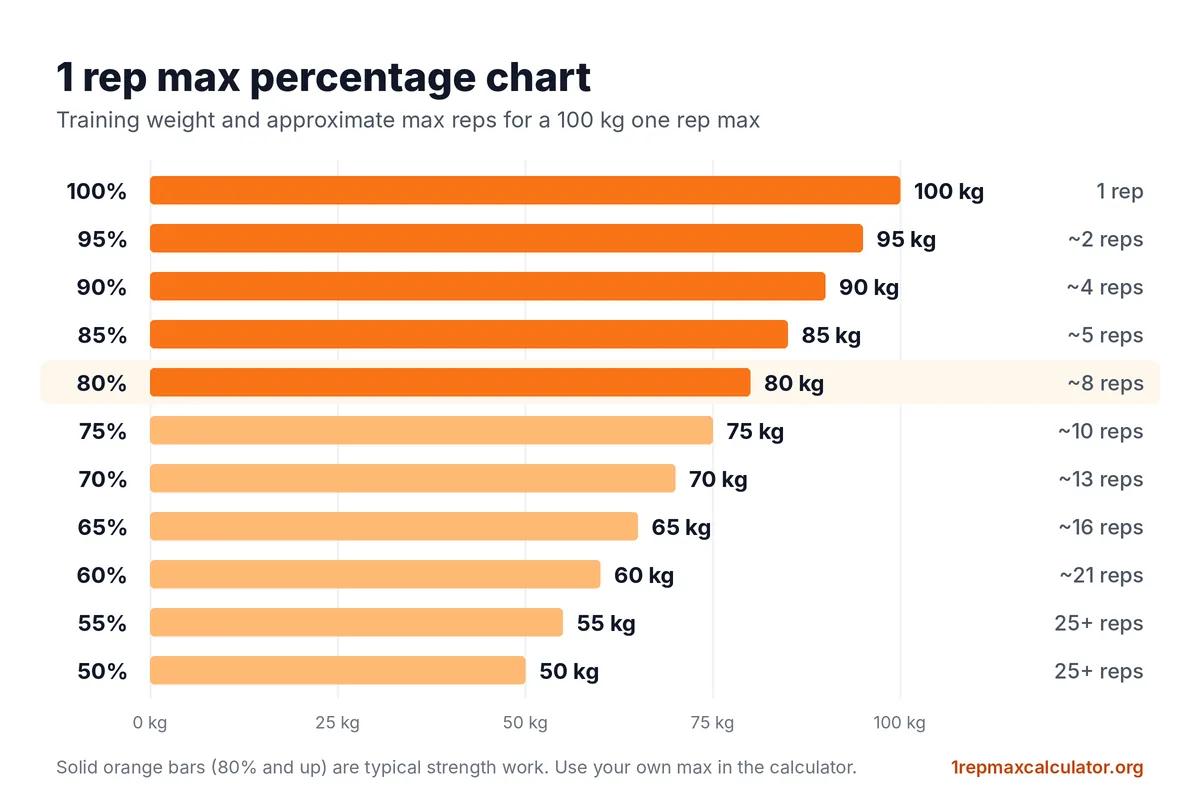
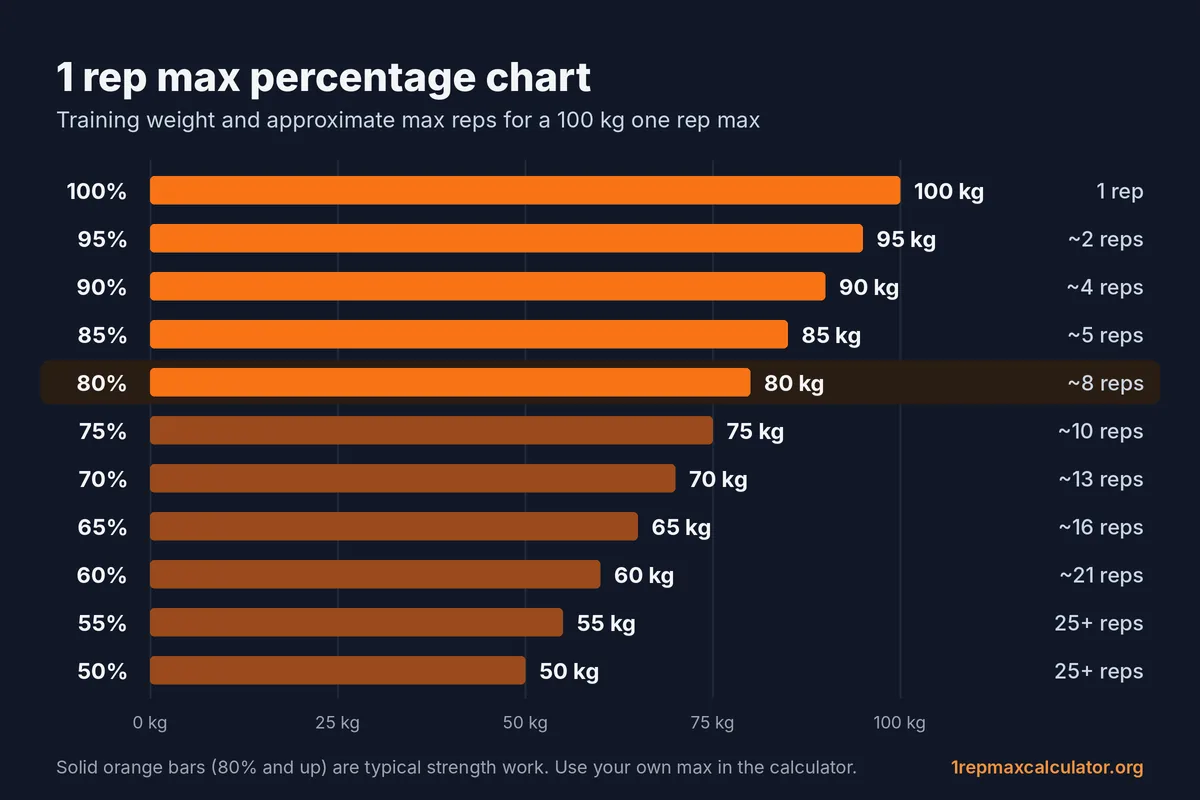
This table uses a 100 kg (225 lb) bench max. The calculator builds the same table for your number, rounded to the plates you have.
| % of max | 100 kg max | 225 lb max | Max reps (approx.) |
|---|---|---|---|
| 95% | 95 kg | 215 lb | 2 |
| 90% | 90 kg | 205 lb | 4 |
| 85% | 85 kg | 190 lb | 5 |
| 80% | 80 kg | 180 lb | 8 |
| 75% | 75 kg | 170 lb | 10 |
| 70% | 70 kg | 160 lb | 13 |
| 65% | 65 kg | 145 lb | 16 |
| 60% | 60 kg | 135 lb | 21 |
Most bench programs live between 70% and 87.5% for working sets. Strength blocks use sets of 3–5 at 80–87.5%. Muscle-building blocks use sets of 6–12 at 65–77.5%.
Programming from your bench max
The bench recovers faster than squats or deadlifts, so most lifters can press heavy twice a week. A simple split that works for years:
- Heavy day: 5 × 3 at 85% (85 kg for a 100 kg max).
- Volume day: 4 × 8 at 70% (70 kg).
- Add 2.5 kg to both days once every set feels crisp, usually every one to two weeks.
Re-check your estimate every four to six weeks with a fresh top set. Then pair your bench with lower-body work from the squat max calculator, and use the plate calculator when the numbers get awkward to load.
Key takeaway
Train your bench from a current estimate, not your best-ever single. Percentages only work when 100% is true today.
Bench Press Max Calculator FAQ
How accurate is a 1 rep max calculator for bench?
For a clean set of 2–10 reps, bench estimates usually land within a few percent of a tested max. Research on bench press prediction found equations were more accurate under 10 reps. Bounced reps and short rest are the main reasons an estimate comes out wrong.
How many reps should I use to estimate my bench max?
Use a set of 3–6 reps with a pause or a clear touch on the chest, finished with good form. If you stopped with reps left, enter the RPE in Coach mode. Avoid sets above 10 reps, where shoulder and triceps fatigue blur the estimate.
Is incline bench max the same as flat bench max?
No. The incline changes the angle and the muscles that do most of the work, so your incline max is usually noticeably lower. Pick Incline Bench Press in the exercise list and track it as its own lift rather than converting from your flat bench.
Should I count touch-and-go reps?
You can, but expect a slightly higher estimate than from paused reps. If you compete or want a strict number, use paused reps. Whatever you choose, stay consistent so your progress chart compares the same kind of set each time.
How often should I re-test my bench press max?
Re-estimate every four to six weeks, or sooner if a weight you used for five reps starts moving for seven. A quick estimate from your normal top set is enough. Save true one-rep tests for a meet or the end of a training block.