
Plate Calculator
This plate calculator shows exactly which plates go on each side of the bar for any target weight, in kg or lb. Need the target first? Our max calculator estimates your 1RM and every training percentage from one set.
Freekg & lbAny barNo sign-up
Load the bar
Enter your max and a percentage to load that weight.
Plates per side
Standard plates
Type a target weight or tap a quick pick to see exactly what goes on each side.
How do you calculate plates for a barbell?
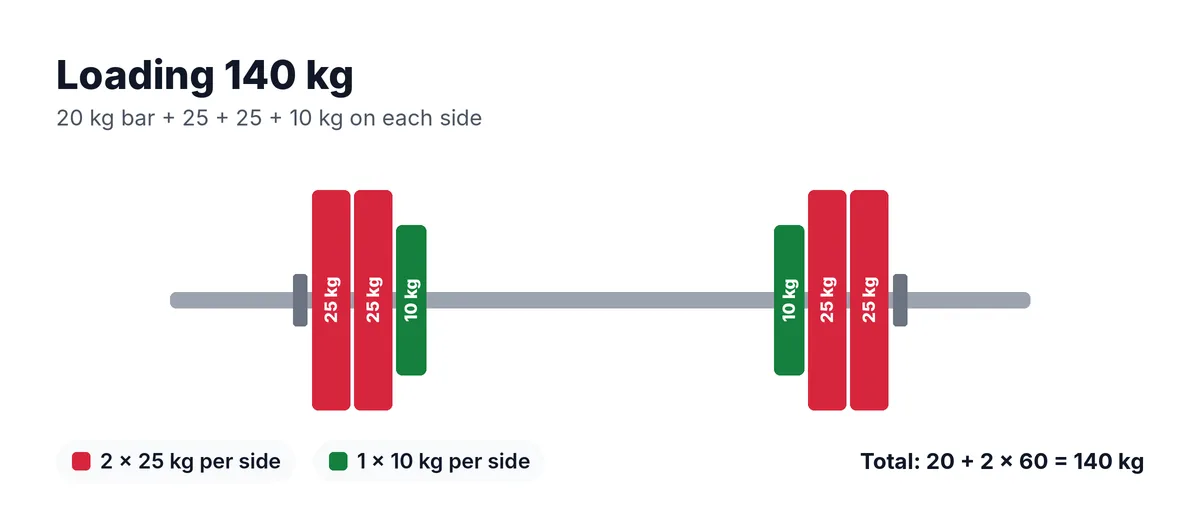
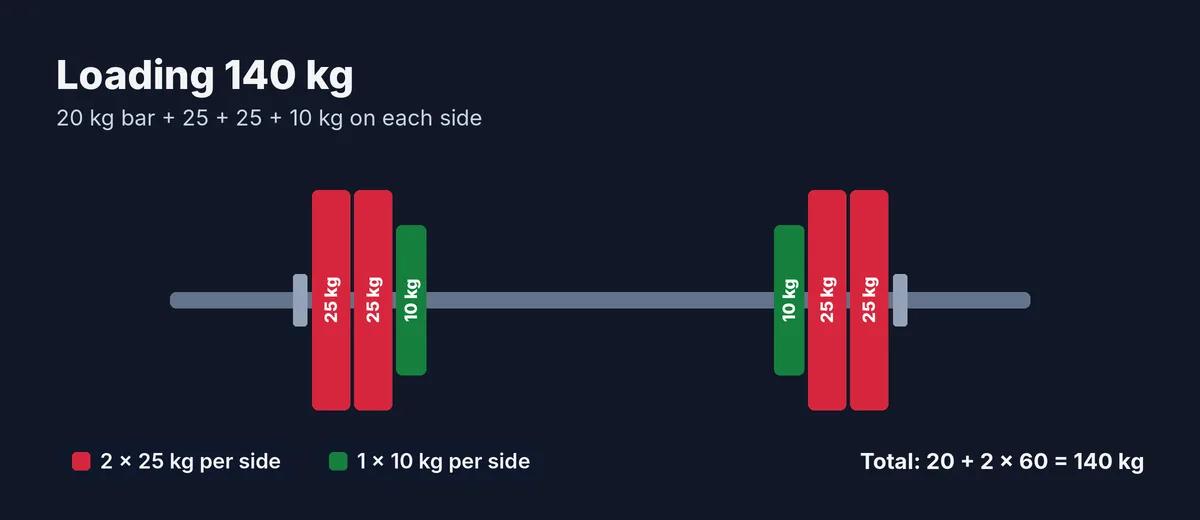
Subtract the bar (and collars) from your target, then divide by two for each side. 140 kg on a 20 kg bar leaves 120 kg, or 60 kg per side: 25 + 25 + 10. Work from the heaviest plate down until the side is full.
How to use the plate calculator
- Choose kg or lb. The plate set and bar options switch with it.
- Enter the target weight or tap a quick pick. The − / + buttons move one pair of the smallest common plates at a time.
- Pick your bar. Men’s 20 kg, women’s 15 kg, a 25 kg trap bar, a 10 kg technique bar, or no bar for plate-loaded machines.
- Add collars if you use competition collars. They weigh 2.5 kg each and the calculator takes them off the plates.
- Load a percentage by entering your max and a percentage. 80% of 150 kg fills the target with 120 kg.
The drawing shows each side of the bar with plates to scale, heaviest on the inside. Share link sends the exact bar to a training partner.
Common loads, worked out
| Target | Bar | Per side |
|---|---|---|
| 60 kg | 20 kg | 20 |
| 100 kg | 20 kg | 25 + 15 |
| 140 kg | 20 kg | 25 + 25 + 10 |
| 140 kg with collars | 20 kg + 2 × 2.5 kg | 25 + 25 + 5 + 2.5 |
| 182.5 kg | 20 kg | 25 + 25 + 25 + 5 + 1.25 |
| 200 kg | 20 kg | 25 + 25 + 25 + 15 |
| 135 lb | 45 lb | 45 |
| 225 lb | 45 lb | 45 + 45 |
| 275 lb | 45 lb | 45 + 45 + 25 |
| 315 lb | 45 lb | 45 + 45 + 45 |
| 405 lb | 45 lb | 45 + 45 + 45 + 45 |
Key takeaway
Load the heaviest plates first and on the inside. It keeps the bar stable, makes unloading easier and is how every competition platform does it.
Plate colours and standard sets
Competition bumper plates follow a colour code set by the International Weightlifting Federation, and most powerlifting plates use the same scheme. The calculator draws plates in these colours so you can spot them on the rack.
| Plate | Colour | Common in |
|---|---|---|
| 25 kg | Red | Competition and calibrated plates |
| 20 kg | Blue | Most gyms |
| 15 kg | Yellow | Bumper sets |
| 10 kg | Green | Bumper sets |
| 5 kg | White | Change plates |
| 2.5 kg | Black or red | Change plates |
| 1.25 kg | Chrome | Fractional sets |
Pound plates are usually all black or grey: 45, 35, 25, 10, 5 and 2.5 lb. In a commercial gym you will rarely find 35s, so the calculator still prefers 45s and 25s when it can.
When a weight can’t be loaded exactly
With standard kg plates the smallest jump is 2.5 kg (two 1.25s). If you ask for 143 kg, the closest you can load is 142.5 kg, and the calculator tells you it is 0.5 kg short.
That matters when you load percentages. 85% of a 152.6 kg squat is 129.7 kg, which you would round to 130 kg. Rounding to the nearest 2.5 kg (or 5 lb) is accurate enough for training; the difference is under 2%.
If you want smaller jumps for presses, fractional plates of 0.5 kg or 1 lb help. Add them by hand after the calculator gives you the base load.
The same goes for pounds. With 2.5 lb as the smallest common plate, every jump is at least 5 lb. A 187 lb target loads as 185 lb: one 45 and one 25 a side on a 45 lb bar.
Bars, collars and machines
- Men’s Olympic bar: 20 kg (about 44 lb), 2.2 m long.
- Women’s Olympic bar: 15 kg, thinner grip, shorter sleeves.
- Standard US bar: 45 lb.
- Trap or hex bar: often 25 kg / 55 lb or more. Check the bar if it is marked.
- Competition collars: 2.5 kg each in powerlifting. Spring clips weigh almost nothing.
- Machines: choose No bar and enter only the plates, so 100 kg on a leg press sled is 50 kg per side.
Loading a warm-up the fast way
Warm-ups are where most plate mistakes happen, because you change the bar every few minutes. A simple system helps.
Build each warm-up on the last one instead of stripping the bar. For a 140 kg top set: 60 kg (20 a side), 100 kg (swap to 25 + 15), 120 kg (25 + 25), then 140 kg (add a 10). Each step adds or swaps only one or two plates per side.
In pounds the same idea works with 45s: 135, 225, 315 and 405 lb are one, two, three and four 45s a side. Most of your warm-up is just adding a plate.
Use the plate calculator once before the session and write the loads on your phone or a whiteboard. Between heavy sets you only need to read the next line, not do maths with a racing heart.
Load your training percentages
The plate calculator pairs naturally with the lift calculators. Estimate your max with the bench press max calculator or the deadlift max calculator, then come back here to load each working set.
A quick example: a 150 kg deadlift max at 80% is 120 kg, or 25 + 25 a side on a 20 kg bar. At 90% it is 135 kg: 25 + 25 + 5 + 2.5 a side.
Key takeaway
Write your loads down before the session. Plate maths between heavy sets is where mistakes happen, and an uneven bar is a dangerous bar.
Plate Calculator FAQ
How do I calculate how many plates to put on each side?
Subtract the bar weight from your target, subtract the collars if you use them, then divide by two. Fill each side from the heaviest plate down. For 140 kg on a 20 kg bar, that is 60 kg per side: 25, 25 and 10.
How much does an Olympic barbell weigh?
A men’s Olympic bar weighs 20 kg, about 44 lb. A women’s bar weighs 15 kg. Standard bars in US gyms are usually listed as 45 lb. Trap bars vary more, often 25 kg or 55 lb, so check the bar before you load it.
Do collars count toward the weight on the bar?
Competition collars do: they weigh 2.5 kg each, so 5 kg in total. In training most people use light spring clips and ignore them. Choose competition collars in the plate calculator and it removes their weight from the plates for you.
What are the standard plate colours?
Competition kg plates follow a standard colour code: 25 kg red, 20 kg blue, 15 kg yellow, 10 kg green and 5 kg white, with smaller change plates in other colours. Pound plates are usually black or grey, so read the number on the plate.
Can I use the plate calculator for machines?
Yes. Choose No bar, then enter the total plate weight you want on the machine. The calculator splits it evenly across both sides. Remember that sleds and carriages have their own weight, which machines rarely list, so compare loads only on the same machine.