
Squat Max Calculator
This squat max calculator estimates your back squat or front squat 1RM from a single hard set, then gives you every working weight you need. It runs on the same seven formulas as our main one rep max calculator, with the Squat preset already selected.
Freekg & lb7 formulasNo sign-up
Your set
Estimated 1RM
Bench Press
Enter the weight and reps from one hard set. Your max, training weights and plate loading appear here instantly.
Enter a set to compare formulas.
Enter a set to build your warm-up.
Enter a set to see the full table.
Type any target weight.
Stored only in this browser on this device. Nothing is sent to our server.
Estimates only. Your real max depends on technique, sleep, and the day. Test heavy singles with a spotter or safeties.
How do you calculate your squat max?
Squat a hard set of 3–6 reps at consistent depth and use Epley: 1RM = weight × (1 + reps ÷ 30). 140 kg × 3 gives 154 kg by Epley. The calculator reports the median of seven formulas: 152.6 kg.
How to use the squat max calculator
Squat is preselected. If you trained front squats, pick Front Squat from the exercise box first, because it is a different lift with a different max.
- Enter the weight on the bar and the reps you finished at full depth.
- Add RPE in Coach mode if you stopped with reps left. 120 kg × 5 at RPE 8 moves the estimate from 139.9 to 145.8 kg.
- Check the range bar. A wide spread usually means the set was too long.
- Use the key weights for your next session, or open the warm-up ramp for a ready-made build-up to your top set.
Everything converts between kg and lb with one tap. A 315 lb set of 5 estimates to 367.2 lb.
Worked squat examples
| Set | Estimated max | Formula range |
|---|---|---|
| 140 kg × 3 | 152.6 kg | 148.2–159.6 kg |
| 120 kg × 5 | 139.9 kg | 135–142.8 kg |
| 120 kg × 5 @ RPE 8 | 145.8 kg | 141–148.8 kg |
| 315 lb × 5 | 367.2 lb | 354.4–374.9 lb |
| Front squat 100 kg × 4 | 112.8 kg | 109.1–116.5 kg |
| 100 kg × 12 | 140 kg | 128.2–144.4 kg |
The 12-rep set gives a 16 kg spread. At that length, breathing and bracing give out before your legs do, so the formulas can’t agree. Keep squat test sets at six reps or fewer. Research on 1RM prediction points the same way: equations work best under 10 reps.
Key takeaway
The best squat estimate comes from a set of 3–6 where every rep hit the same depth as the first.
Squat technique for an accurate max
Depth and brace checklist
- Big breath into your belly and brace before every rep, not only the first.
- Hip crease below the top of the knee on every rep, including the last.
- Same bar position each time. High bar and low bar are different lifts.
- Weight over the mid-foot, heels down, knees tracking over the toes.
- Stand all the way up before the next rep starts.
Where estimates go wrong
Depth creeps up as you tire. Rep one is a full squat, rep five is two inches high, and the calculator counts both. The estimate comes out higher than you could squat to legal depth.
The other common error is hips shooting up first so the rep turns into a good morning. That rep completes, but it would not hold up on a heavy single. Film one set from the side every few weeks to check.
Front squats
Front squats end when your upper back rounds or the elbows drop, often before your legs are done. Use sets of 2–5 and track the front squat as its own lift.
Squat max calculator vs testing a true max
Testing a heavy squat single is hard on the body. It takes a long warm-up, safety pins or two spotters, and often a few days of reduced training afterwards.
A squat max calculator gets you a usable number from your normal top set. Squat 120 kg for 5 and you know your max is close to 140 kg, with no extra risk and no lost training days.
There are still times to test. A meet is the obvious one. The end of a long training block is another, because it shows whether your estimates have been running high or low.
If your tested max is consistently above your estimate, your squat has good strength-endurance for its size. If it lands below, your sets have probably been running long or depth has been drifting. Either way, adjust and keep estimating.
Squat percentage chart
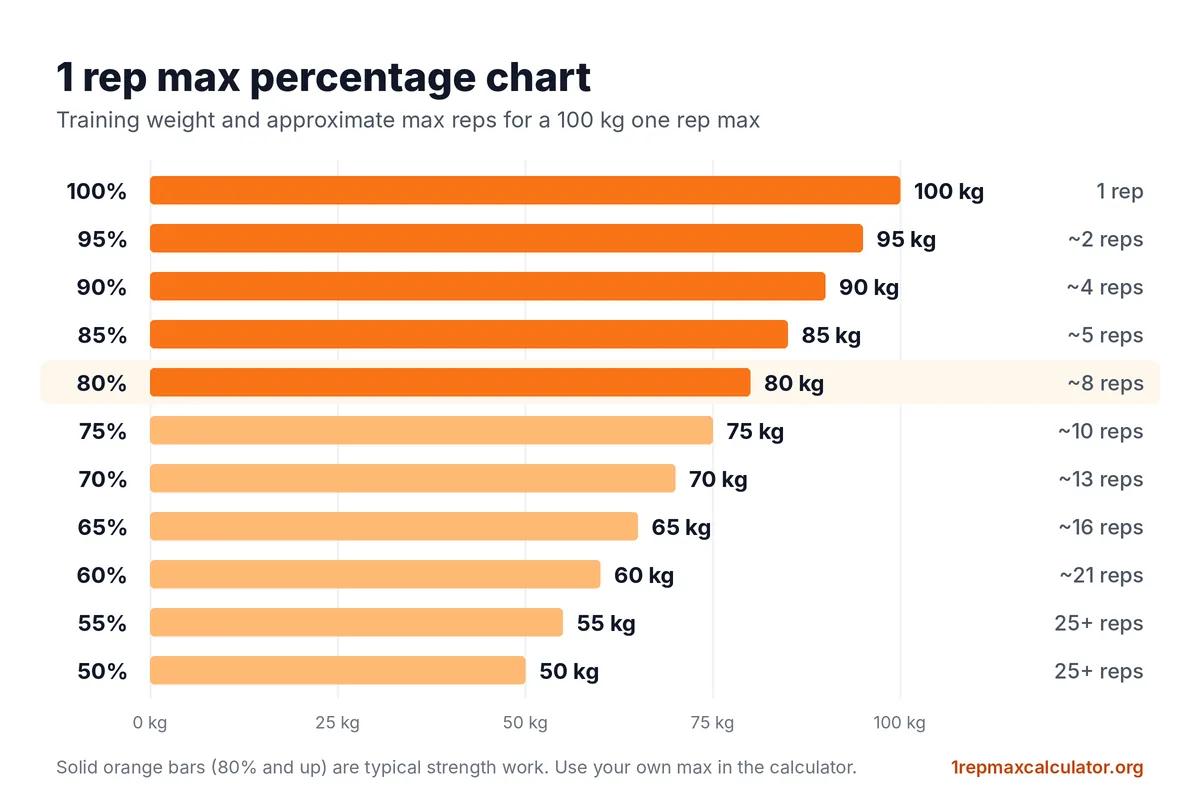
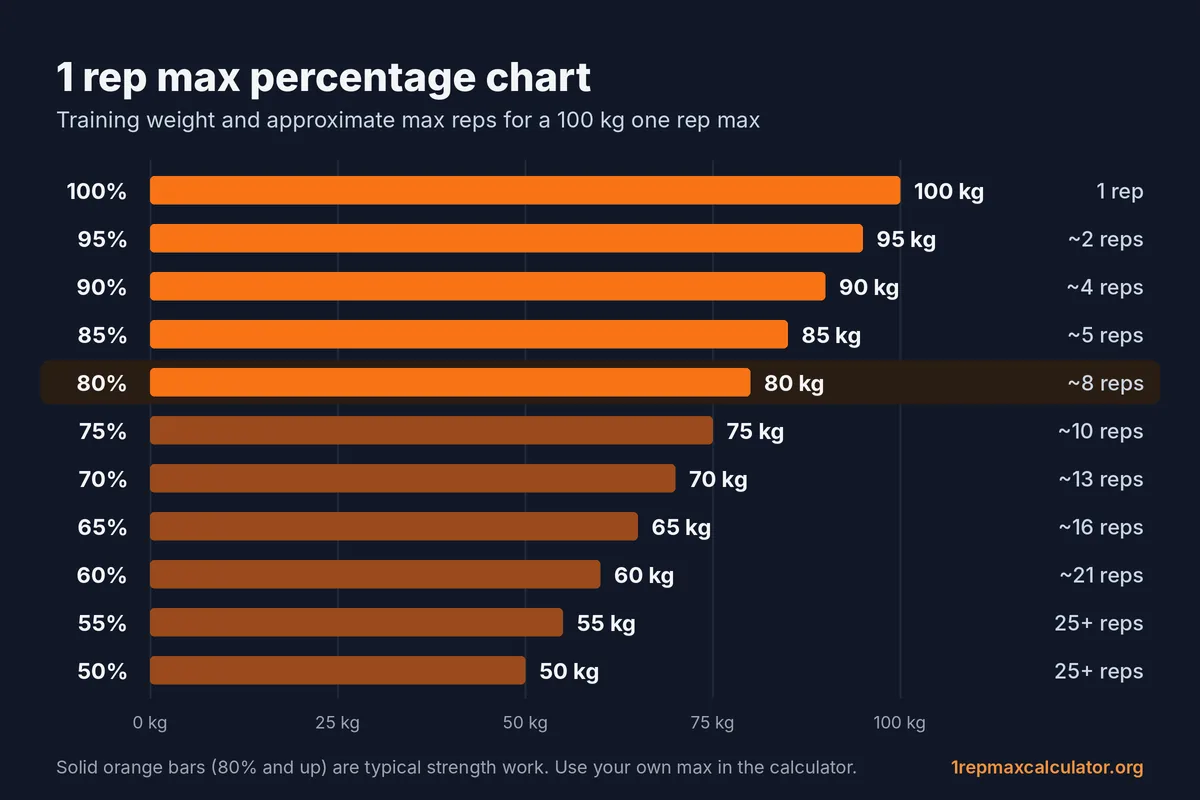
This table uses a 140 kg (315 lb) squat max, rounded to 2.5 kg and 5 lb jumps.
| % of max | 140 kg max | 315 lb max | Max reps (approx.) |
|---|---|---|---|
| 95% | 132.5 kg | 300 lb | 2 |
| 90% | 125 kg | 285 lb | 4 |
| 85% | 120 kg | 270 lb | 5 |
| 80% | 112.5 kg | 250 lb | 8 |
| 75% | 105 kg | 235 lb | 10 |
| 70% | 97.5 kg | 220 lb | 13 |
| 65% | 90 kg | 205 lb | 16 |
| 60% | 85 kg | 190 lb | 21 |
For strength, most squat work sits at 80–90% for sets of 2–5. For size, 65–77.5% for sets of 6–10 is plenty heavy, as long as depth stays honest.
Programming from your squat max
Squats respond well to two sessions a week. With a 152.5 kg estimate, a solid week looks like this:
- Monday: 5 × 3 at 85%, which is 130 kg.
- Thursday: 4 × 8 at 70%, which is 107.5 kg.
- Progress by 2.5–5 kg a week while every rep hits depth.
Running 5/3/1 or a similar plan? Switch the percentage table to Training max in Coach mode. A 90% training max on a 152.6 kg squat gives 137.5 kg to build from.
Heavy squats and heavy pulls share the same recovery, so plan them together with the deadlift max calculator. When a percentage lands on an odd number, the plate calculator shows exactly what to put on the bar.
Key takeaway
Re-estimate your squat every four to six weeks. Squats often move fast early on, and training off an old max leaves strength on the table.
Squat Max Calculator FAQ
How accurate is a squat max calculator?
With a clean set of 2–6 reps at consistent depth, a squat max calculator usually lands within a few percent of a tested max. Accuracy drops on long sets, where bracing and breathing fade before your legs, and when depth gets shallower as the set goes on.
How many reps should I squat to estimate my max?
Use a set of 3–6 reps, taken after a full warm-up and at least three minutes of rest. Every rep should hit the same depth. If you stopped with reps left, add the RPE in Coach mode so the estimate counts them.
Is my front squat max the same as my back squat max?
No. Most lifters front squat noticeably less than they back squat, because the upper back and rack position limit the lift before the legs do. Select Front Squat in the calculator and track it separately instead of trying to convert it from your back squat number.
Does high bar or low bar change my squat max?
Yes. Low bar usually allows more weight because the bar sits lower on the back and the hips do more of the work. Treat them as different lifts, and keep the same bar position every time you estimate so your progress chart stays comparable.
How often should I test my squat max?
Re-estimate every four to six weeks from a normal top set. A true one-rep squat test is hard on recovery, so keep it for meets or the end of a training block. Always use safety pins or spotters for heavy singles.