
Deadlift Max Calculator
This deadlift max calculator estimates your one-rep deadlift from a single set, for conventional, sumo or trap bar pulls. It is the deadlift version of our 1rm calculator, with rep advice built around how pulls actually fatigue.
Freekg & lb7 formulasNo sign-up
Your set
Estimated 1RM
Bench Press
Enter the weight and reps from one hard set. Your max, training weights and plate loading appear here instantly.
Enter a set to compare formulas.
Enter a set to build your warm-up.
Enter a set to see the full table.
Type any target weight.
Stored only in this browser on this device. Nothing is sent to our server.
Estimates only. Your real max depends on technique, sleep, and the day. Test heavy singles with a spotter or safeties.
How do you calculate your deadlift max?
Pull a crisp set of 2–5 reps, resetting each rep from the floor, and use Epley: 1RM = weight × (1 + reps ÷ 30). 180 kg × 3 gives 198 kg by Epley. The calculator’s median of seven formulas is 196.2 kg.
How to use the deadlift max calculator
Deadlift (Conventional) is preselected. Switch to Sumo, Trap Bar or Romanian Deadlift in the exercise box if that is what you pulled.
- Enter the weight and reps from your heaviest clean set. Two to five reps is the sweet spot.
- Add RPE in Coach mode if you left reps in the tank.
- Check the range bar and the coaching note for the lift.
- Open the warm-up ramp for ready-to-load sets up to your top set.
Pulling with a trap bar? Choose the 25 kg (55 lb) trap bar in the plate tool, because the bar weighs more than a standard Olympic bar.
Worked deadlift examples
| Set | Estimated max | Formula range |
|---|---|---|
| 180 kg × 3 | 196.2 kg | 190.6–205.2 kg |
| 160 kg × 5 | 186.5 kg | 180–190.4 kg |
| 405 lb × 3 | 441.4 lb | 428.8–461.7 lb |
| Sumo 170 kg × 4 | 191.8 kg | 185.5–198.1 kg |
| Trap bar 200 kg × 5 | 233.2 kg | 225–238 kg |
| 150 kg × 8 | 187.7 kg | 180–191.5 kg |
The 8-rep set predicts a lower max than the triple for most lifters, even when the true max is the same. Grip and back fatigue end long deadlift sets early, so the formulas underestimate you. Studies on 1RM prediction equations also found them most accurate on sets under 10 reps.
Key takeaway
For deadlifts, a crisp triple tells the truth. A grinding set of eight usually sells you short.
Why deadlift reps behave differently
The first rep of a deadlift starts from a dead stop with fresh grip and perfect position. Every rep after that is a little different: the bar drifts, the hips start higher, the breath gets shorter.
Bench and squat sets look much the same on rep one and rep six. Deadlift sets rarely do. That is why rep-based formulas, which were mostly built on presses and squats, fit pulls less tightly above five reps.
Conventional vs sumo
Conventional pulls lean on the back and hamstrings. Sumo shortens the range of motion and loads the hips and adductors. Track them as separate lifts; a sumo max does not convert neatly to a conventional one.
Trap bar and Romanian deadlift
The trap bar keeps the load in line with your body, so most lifters move more weight on it. Its max is great for programming trap bar work, but not for predicting a straight-bar pull.
The Romanian deadlift has no floor start and stops when your hamstrings reach their stretch. 120 kg × 8 on RDLs estimates to 150.1 kg, a useful number for setting RDL sets, not your deadlift.
Deadlift technique checklist
- Bar over the mid-foot before you start, close to the shins.
- Brace, pull the slack out of the bar, then push the floor away.
- Reset each rep from a dead stop. Touch-and-go adds reps you can’t repeat cold.
- Finish every rep: hips and knees locked, shoulders behind the bar.
- Stop the set when your back position changes, even if you could grind another.
Warming up to a heavy pull
Deadlift warm-ups can be shorter than squat warm-ups, but the jumps need to be sensible. Open the warm-up ramp in Coach mode and pick your top set percentage. It lays out every set with weight, %1RM, reps and rest.
For a 196 kg estimate and a top set at 85% (167.5 kg), a typical ramp looks like this: empty bar for a few reps, then about 67.5 kg × 5, 92.5 kg × 4, 117.5 kg × 3, 135 kg × 2 and 150 kg × 1 before the work set.
Keep the reps low as the weight climbs. The goal is to practise the position and wake up your grip, not to tire yourself out before the set that matters.
Use the same warm-up every time you estimate. A deadlift max calculator can only compare like with like, and a rushed warm-up is one of the quickest ways to get a low number.
Deadlift percentage chart
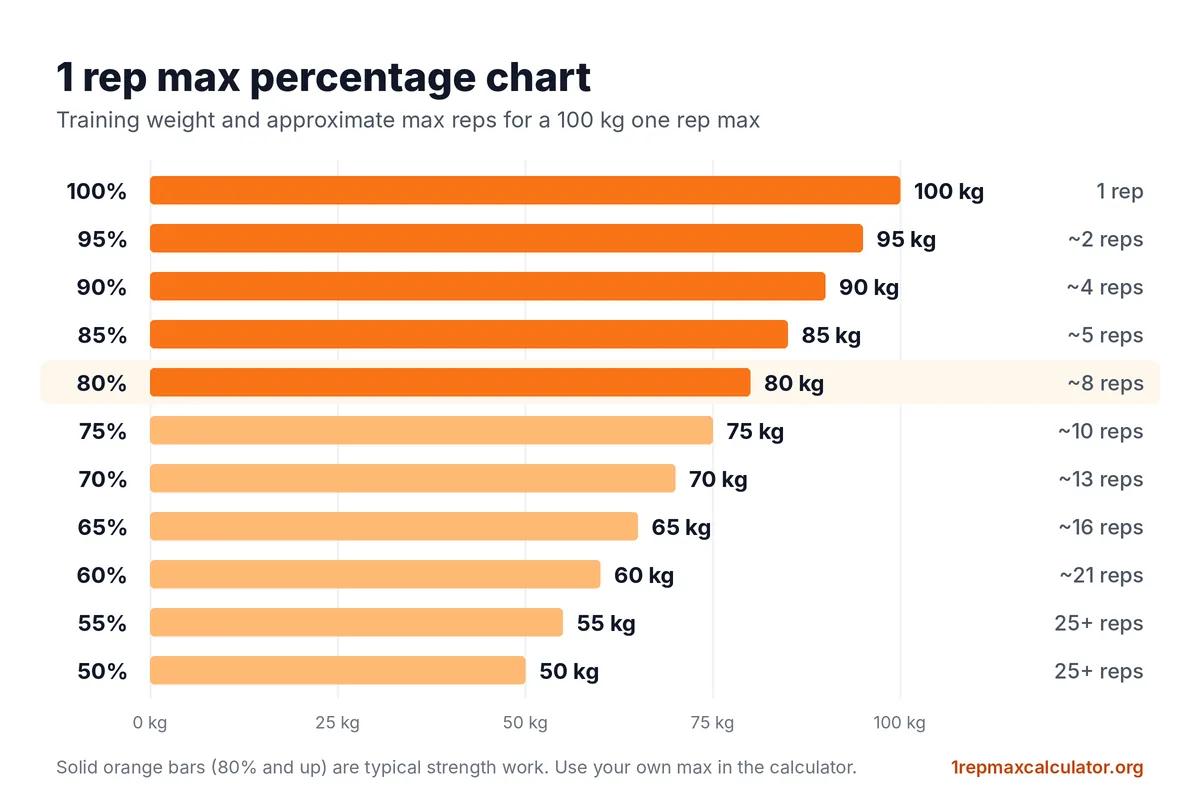
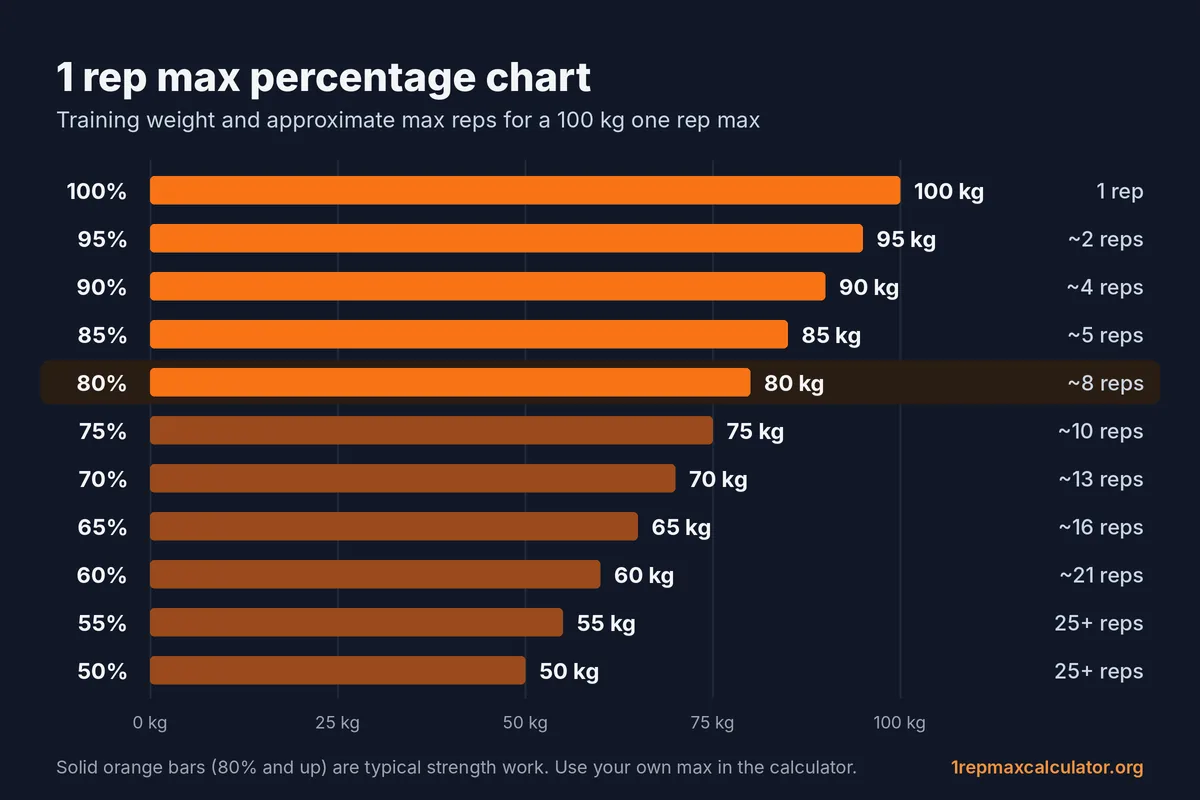
This table uses a 180 kg (405 lb) deadlift max, rounded to 2.5 kg and 5 lb.
| % of max | 180 kg max | 405 lb max | Max reps (approx.) |
|---|---|---|---|
| 95% | 170 kg | 385 lb | 2 |
| 90% | 162.5 kg | 365 lb | 4 |
| 85% | 152.5 kg | 345 lb | 5 |
| 80% | 145 kg | 325 lb | 8 |
| 75% | 135 kg | 305 lb | 10 |
| 70% | 125 kg | 285 lb | 13 |
| 65% | 117.5 kg | 265 lb | 16 |
| 60% | 107.5 kg | 245 lb | 21 |
Real deadlift rep maxes often fall a rep or two short of the “max reps” column at 75% and below, for the reasons above. Plan working sets well inside those numbers.
Programming from your deadlift max
Most lifters do well with one heavy pull a week plus lighter hinge work. With a 196 kg estimate:
- Heavy day: 4 × 2 at 85–90%, about 167.5–175 kg.
- Light day: 3 × 6 Romanian deadlifts, or speed pulls at 60% (117.5 kg) for 6 × 2.
- Rest 3–5 minutes between heavy sets.
Heavy pulls and heavy squats share recovery, so check your numbers in the squat max calculator when you plan the week. For awkward loads like 182.5 kg, the plate calculator shows 25 + 25 + 25 + 5 + 1.25 per side on a 20 kg bar.
Key takeaway
Deadlifts reward quality over volume. Fewer, cleaner reps build a bigger pull and a more honest max.
Deadlift Max Calculator FAQ
How accurate is a deadlift max calculator?
For crisp sets of 2–5 reps, a deadlift max calculator is usually close enough to program from. Accuracy drops faster than for bench or squat on longer sets, because grip and back fatigue end the set early. That makes long deadlift sets predict a lower max than you really have.
How many reps should I use to estimate my deadlift max?
Use 2–5 reps, resetting each rep from the floor. Triples are ideal for most lifters because grip and position hold up well. Avoid sets above eight reps for estimating, and stop the set as soon as your back position changes, even if you could grind out another.
Is a sumo max the same as a conventional max?
Not usually. Some lifters pull more sumo, some more conventional, and the gap varies from person to person. Select Sumo Deadlift in the calculator and track it as its own lift, so your progress chart always compares like with like over time.
Can I use a trap bar set to estimate my deadlift?
You can estimate your trap bar max, but not your straight-bar deadlift. Most lifters handle more weight on the trap bar because the load sits in line with the body. Choose Trap Bar Deadlift and use the 25 kg bar setting in the plate tool.
How often should I test my deadlift max?
Re-estimate every four to eight weeks from a normal top set. True max deadlifts are very demanding and can affect training for days. Save them for meets or a planned test day, and warm up with the ramp in Coach mode.