
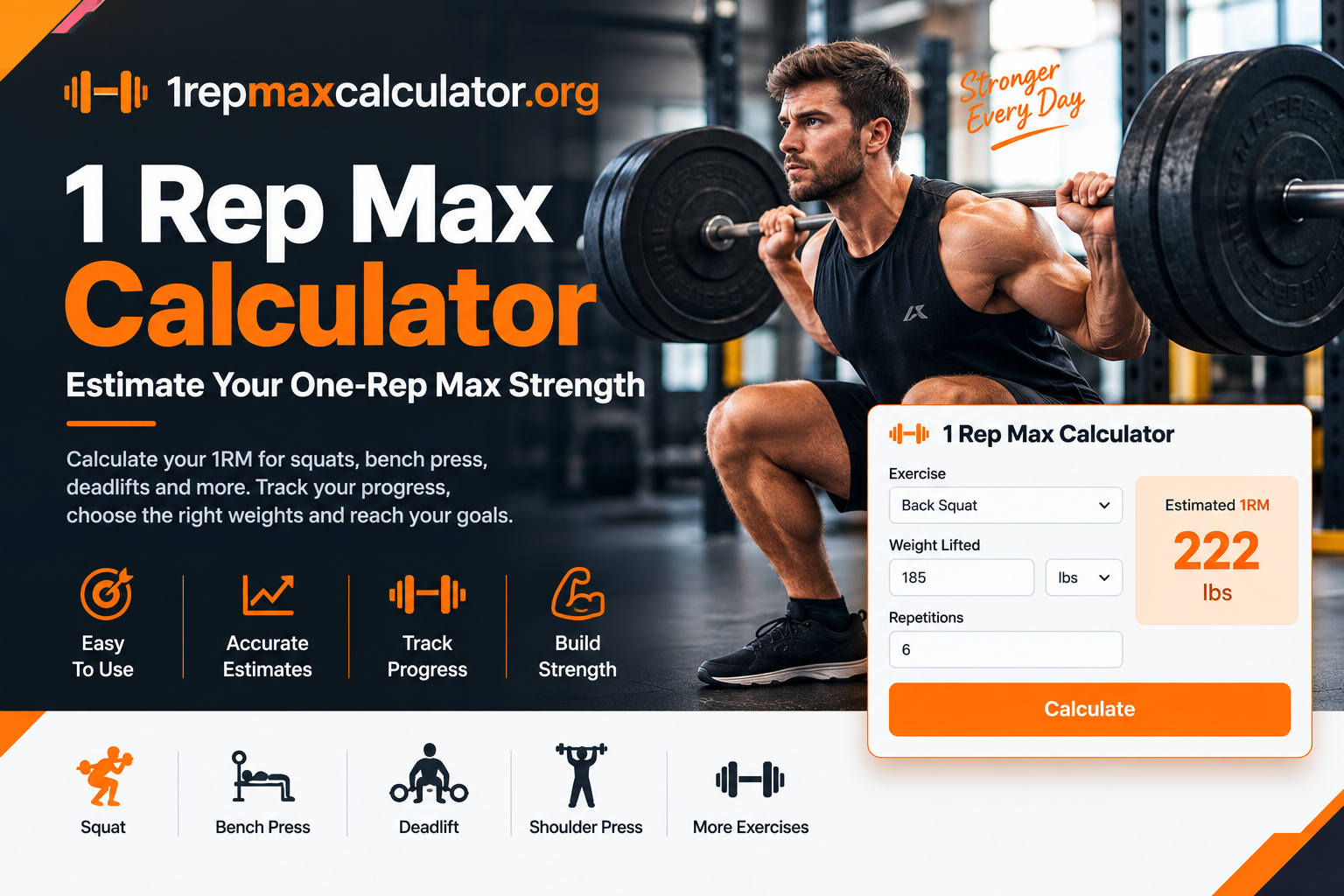
1 Rep Max Calculator – Estimate Your One-Rep Max Strength
A 1 Rep Max Calculator helps you estimate the maximum weight you can lift for a single repetition of an exercise. Whether you are training for strength, improving your gym performance, or planning your next workout program, knowing your one-rep max (1RM) gives you a useful starting point for measuring progress and choosing appropriate training weights.
Instead of attempting a dangerous maximum lift every time you want to assess your strength, you can use your current lifting weight and repetitions to estimate your maximum capacity. This approach works well for popular compound exercises, including squats, bench presses, and deadlifts.
What Is a 1 Rep Max Calculator?
A 1 Rep Max Calculator is a fitness tool that estimates the heaviest weight you could lift for one complete repetition with proper technique. This measurement is commonly called your one-repetition maximum or 1RM.
For example, if you can bench press 135 pounds for five repetitions, a calculator can estimate the maximum weight you might lift for one repetition. The result is an estimate rather than a guarantee because individual strength, technique, fatigue, and exercise experience affect actual performance.
One-rep maximum testing is widely used in strength training, powerlifting, and resistance exercise programming. Coaches use estimated 1RM values to determine training intensity and track an athlete’s development over time.
You do not need to perform an actual maximum lift to benefit from this measurement. A challenging set performed with controlled technique can provide enough information to calculate a practical estimate.
How to Use the 1 Rep Max Calculator
Calculating your estimated maximum is straightforward. Follow these steps to get a useful result from the tool.
- Select your exercise: Choose the movement you want to evaluate, such as the squat, bench press, or deadlift.
- Enter the weight: Input the weight you successfully lifted during your working set.
- Add your repetitions: Enter the number of complete repetitions you performed with that weight.
- Calculate your result: Run the calculator to estimate your one-repetition maximum.
- Review your training percentages: Use the result to identify suitable working weights for different strength-training goals.
For the most useful estimate, choose a recent set performed with consistent technique and a weight that genuinely challenges you. Avoid entering repetitions that required assistance or involved incomplete movements.
Results become less reliable when the repetition count is high. For practical strength programming, a challenging set of approximately two to ten repetitions often provides a useful estimate, although accuracy varies between lifters and exercises.
How Is One Rep Max Calculated?
Several mathematical formulas can estimate your one-repetition maximum. Each uses the weight lifted and the number of completed repetitions to predict your maximum strength.
One commonly used method is the Epley formula:
Epley Formula
Estimated 1RM = Weight × (1 + Repetitions ÷ 30)
Suppose you bench press 100 pounds for eight repetitions.
Estimated 1RM = 100 × (1 + 8 ÷ 30)
Estimated 1RM = 100 × 1.2667
Estimated one-rep max = 126.7 pounds
This result suggests that your estimated maximum bench press is approximately 127 pounds.
Another widely used method is the Brzycki formula:
Brzycki Formula
Estimated 1RM = Weight × 36 ÷ (37 − Repetitions)
Using the same example:
Estimated 1RM = 100 × 36 ÷ (37 − 8)
Estimated 1RM = 3,600 ÷ 29
Estimated one-rep max = 124.1 pounds
The two formulas produce slightly different results because they use different mathematical models. Neither can perfectly predict every lifter’s performance.
For everyday training, choose a consistent calculation method and use it to monitor progress over time. Comparing estimates generated with the same formula makes it easier to identify meaningful changes in strength.
Squat Max Calculator: Estimate Your Maximum Squat
A Squat Max Calculator helps you estimate the heaviest weight you could squat for one repetition based on a recent training set. It is particularly useful for lifters who want to improve lower-body strength without frequently attempting maximum-effort squats.
The squat involves several muscle groups, including the quadriceps, glutes, hamstrings, and muscles that stabilize the trunk. Because the movement requires coordination and controlled technique, your estimated squat maximum depends on more than muscle strength alone.
To calculate your estimated squat max, enter the weight you lifted and the number of repetitions completed.
For example, suppose you squat 185 pounds for six repetitions.
Using the Epley formula:
Estimated squat 1RM = 185 × (1 + 6 ÷ 30)
Estimated squat 1RM = 185 × 1.20
Estimated squat max = 222 pounds
This number provides a starting point for selecting squat training loads. Your actual maximum may be higher or lower depending on squat depth, technique, fatigue, and training experience.
For consistent comparisons, use the same squat variation and similar movement standards each time you calculate your maximum. A high-bar back squat, low-bar back squat, and front squat should not automatically be treated as equivalent lifts.
1 Rep Max Examples for Popular Exercises
A one-rep max estimate can be useful for different resistance exercises. The following examples demonstrate how the Epley formula works with several common lifts.
| Exercise | Weight Lifted | Repetitions | Estimated 1RM |
|---|---|---|---|
| Bench press | 135 lb | 5 | 158 lb |
| Back squat | 185 lb | 6 | 222 lb |
| Deadlift | 225 lb | 5 | 263 lb |
| Overhead press | 75 lb | 8 | 95 lb |
| Dumbbell press | 50 lb | 6 | 60 lb |
These figures are illustrative estimates, not strength standards or guaranteed maximum lifts. For dumbbell exercises, clarify whether the entered weight represents one dumbbell or the combined weight of both.
Your estimated maximum also depends on how the exercise is performed. Different ranges of motion, equipment, grip positions, and lifting techniques can affect the result.
Understanding 1RM Training Percentages
Once you know your estimated one-rep max, you can calculate working weights for different training intensities. Many strength programs prescribe loads as a percentage of 1RM rather than using the same weight for every workout.
The table below shows example training weights for an estimated one-rep max of 200 pounds.
| Percentage of 1RM | Training Weight | Common Application |
|---|---|---|
| 50% | 100 lb | Light practice and technique |
| 60% | 120 lb | Technique-focused training |
| 70% | 140 lb | Moderate resistance work |
| 75% | 150 lb | General strength development |
| 80% | 160 lb | Challenging strength sets |
| 85% | 170 lb | Heavy strength training |
| 90% | 180 lb | High-intensity lifting |
| 95% | 190 lb | Near-maximal training |
These percentages are approximate programming references, not universal prescriptions. The appropriate load depends on your training plan, experience, recovery, and the number of repetitions you intend to complete.
For example, 80% of your 1RM might be appropriate for several repetitions in some exercises, but it may feel substantially harder on another day. Sleep, nutrition, stress, and accumulated fatigue can influence performance.
Beginners generally benefit from learning correct movement patterns and building a consistent training routine before regularly using heavy loads.
Benefits of Knowing Your One-Rep Max
Estimating your one-rep max provides several practical advantages for structured strength training.
1. Set More Appropriate Training Weights
Knowing your estimated maximum helps you choose weights based on your current strength rather than guessing. You can use training percentages to establish a starting load for different exercises and adjust it according to your program.
2. Track Strength Progress
Repeating the calculation periodically helps you monitor improvements. If you lift more weight for the same number of repetitions, your estimated maximum may increase.
For example, progressing from a bench press of 100 pounds for five repetitions to 110 pounds for five repetitions suggests an improvement in estimated strength, assuming comparable technique and effort.
3. Plan Strength Training Programs
Many structured lifting programs use percentages of 1RM to organize training intensity. An estimated maximum can help you plan lighter sessions, moderate working sets, and heavier strength-focused workouts.
However, percentages should complement your training plan rather than replace attention to technique and recovery.
4. Avoid Unnecessary Maximum Testing
Testing your true maximum requires lifting a very heavy weight and may be demanding, especially for inexperienced lifters. An estimate based on a submaximal set can provide useful programming information without requiring a maximum attempt.
This does not eliminate injury risk, but it can reduce the need to perform frequent all-out lifts.
5. Compare Performance Over Time
Consistent measurements make it easier to evaluate progress across training blocks. Recording the exercise, weight, repetitions, and estimated maximum provides a more informative training history than recording weight alone.
Estimated 1RM vs. Actual 1RM
An estimated one-rep max and an actual one-rep max are related measurements, but they are not identical.
An estimated 1RM is calculated from a set of multiple repetitions. It predicts the weight you might lift once using a mathematical formula.
An actual 1RM is the heaviest load you successfully lift for one complete repetition under the conditions of the test.
The estimated value is convenient for everyday training because it does not require a maximal attempt. The actual value measures performance directly, but testing it requires appropriate preparation, technique, and safety precautions.
Several factors can create differences between these measurements:
- Repetition ability: Some lifters can perform more repetitions at a given percentage of their maximum than others.
- Exercise selection: Bench presses, squats, deadlifts, and isolation exercises may produce different estimation accuracy.
- Technique: Changes in movement depth, range of motion, or execution can influence the result.
- Fatigue: Poor recovery or a demanding workout can reduce your performance.
- Experience: Experienced lifters may have better technique and greater familiarity with heavy loads.
For most training decisions, an estimated 1RM is best treated as a practical reference rather than an exact measurement.
How Accurate Is a 1 Rep Max Calculator?
A 1 Rep Max Calculator can provide a useful estimate, but its accuracy depends on the quality of the information you enter and the formula being used.
Estimates tend to be more useful when you perform a controlled set with a manageable number of repetitions. As repetition counts increase, individual differences in muscular endurance can make predictions less precise.
Accuracy may also vary between exercises. A formula that provides a reasonable bench press estimate for one person might overestimate or underestimate another person’s squat maximum.
To improve consistency, follow these guidelines:
- Use a recent working set rather than an old personal record.
- Enter only completed repetitions performed with proper technique.
- Avoid calculating your maximum from a set that was interrupted or assisted.
- Use the same formula when comparing results over time.
- Repeat measurements under reasonably similar conditions.
- Consider your perceived effort and recovery when selecting training weights.
Remember that even a mathematically accurate estimate does not account for every factor affecting your performance on a particular day.
How to Use Your 1RM for Muscle Growth
Although one-rep maximum measurements are commonly associated with strength training, they can also help organize workouts designed to build muscle.
Muscle growth depends on several factors, including training volume, effort, exercise selection, recovery, and progressive overload. You do not need to lift near your maximum for every set to stimulate muscle growth.
Once you know your estimated 1RM, you can use percentages as a general guide for choosing resistance. For example, moderate loads may allow you to perform several controlled repetitions while maintaining good technique.
Your ideal working weight should match your exercise selection, target repetition range, and training experience. A percentage chart provides a starting point, but it should not dictate every decision.
For hypertrophy-focused training, concentrate on completing controlled repetitions, gradually increasing training demands, and recovering adequately between sessions. Record your performance so that you can adjust your weights as your strength improves.
Common Mistakes When Calculating One-Rep Max
Small errors in your training data can produce misleading estimates. Avoid these common mistakes when using a 1 Rep Max Calculator.
Entering the Wrong Weight
Check whether your weight is recorded in pounds or kilograms. Mixing measurement units can produce an incorrect result. If you use dumbbells, confirm whether the calculator expects the weight of one dumbbell or both combined.
Counting Incomplete Repetitions
Only include repetitions completed according to your normal technique standards. Partial movements, assisted repetitions, or repetitions performed with substantial changes in form can make the estimate less representative of your strength.
Using Excessive Repetition Counts
High-repetition sets can introduce greater uncertainty because muscular endurance varies considerably between individuals. A challenging set with fewer repetitions may provide a more useful estimate for strength programming.
Treating the Result as an Exact Number
Your estimated maximum is not a permanent measure of ability. Daily readiness, training adaptations, and technique can affect actual performance. Avoid changing your entire training program because of a small fluctuation in the calculated result.
Ignoring Recovery and Technique
A heavier weight is not automatically better if it compromises your form. Build strength gradually and prioritize consistent execution rather than chasing a higher estimated maximum every session.
Safety Tips Before Testing Your Maximum Strength
Strength training can be effective and rewarding when performed with appropriate technique and sensible progression. However, heavy lifting places considerable demands on your muscles, joints, and supporting structures.
Before performing challenging sets, warm up with lighter loads and gradually increase the weight as appropriate. Use a controlled range of motion that matches your exercise and training goals.
For heavy barbell squats and bench presses, use appropriate safety equipment, such as correctly positioned rack safeties or a competent spotter. Avoid attempting unfamiliar maximum lifts without suitable instruction and preparation.
Stop a set if you experience sharp pain, dizziness, or a sudden loss of control. Do not treat discomfort caused by an injury as something you must push through to achieve a higher number.
Beginners should focus on developing technique and building a reliable training foundation before attempting true one-repetition maximum tests. When in doubt, seek guidance from a qualified fitness professional.
Frequently Asked Questions
What does 1RM mean in weightlifting?
1RM stands for one-repetition maximum. It represents the heaviest weight you can lift for one complete repetition of a specific exercise while following the required movement standards.
How do I calculate my one-rep max?
You can estimate your one-rep max by entering the weight you lifted and the number of repetitions completed into a calculator. The Epley formula is one common method: estimated 1RM = weight × (1 + repetitions ÷ 30).
Is a 1 Rep Max Calculator accurate?
It can provide a useful estimate, but the result is not guaranteed to match your actual maximum. Accuracy depends on the formula, repetition count, exercise, technique, and individual strength characteristics.
How does a Squat Max Calculator work?
A Squat Max Calculator uses your squat weight and completed repetitions to estimate your maximum single-repetition squat. For example, squatting 185 pounds for six repetitions produces an estimated 1RM of 222 pounds using the Epley formula.
Should beginners test their one-rep max?
Beginners generally do not need to test a true maximum. An estimate based on a controlled set can help guide training while they develop proper technique and consistency.
How often should I calculate my 1RM?
You can recalculate your estimated maximum periodically, such as when reviewing a training block or noticing consistent improvements. There is no universal schedule; calculate it when the result will help inform your programming.
Can I calculate my 1RM in kilograms?
Yes. The same formulas work with kilograms or pounds, provided you enter the weight consistently and interpret the result in the same unit.
What is a good one-rep max?
A good one-rep max depends on your body weight, age, training experience, exercise technique, and individual goals. Rather than relying on a single universal number, compare your progress over time and use suitable strength standards for your circumstances.
Is estimated 1RM useful for muscle building?
Yes. An estimated 1RM can help you choose and adjust training weights. However, muscle growth also depends on training volume, effort, exercise selection, nutrition, and recovery.
Conclusion
A 1 Rep Max Calculator provides a practical way to estimate your maximum lifting strength without repeatedly attempting an all-out lift. By entering your working weight and completed repetitions, you can obtain an estimate that supports training decisions, progress tracking, and workout planning.
A Squat Max Calculator applies the same principle to lower-body strength, helping you estimate your squat maximum and choose appropriate working loads. Whether your goal is to improve your bench press, build a stronger squat, increase your deadlift, or develop a more structured gym routine, estimated 1RM values can help you make more informed decisions.